Start again in 3... 2... 1...
"Thank you! Thank you for the emotions and memories you've given us."
These are certainly the words that many winegrowers "whisper" to their old vines when it comes to restructuring a vineyard. A new cycle is about to begin, with different grape varieties or different methods of management that always aim to improve the emotions and memories that the new vines will share with us over the next few years.
Start again in 3... 2... 1...
"Thank you! Thank you for the emotions and memories you've given us."
These are certainly the words that many winegrowers "whisper" to their old vines when it comes to restructuring a vineyard. A new cycle is about to begin, with different grape varieties or different methods of management that always aim to improve the emotions and memories that the new vines will share with us over the next few years.
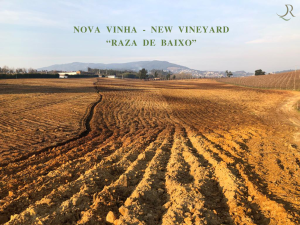
Choosing the orientation of the rows of vines is an important factor when planting a vineyard. Protecting the bunches from the sun during the hottest hours, counteracting erosion and facilitating mechanization are some of the most important aspects to bear in mind. In this particular case, the vineyard will be oriented to the south, which means that during the hours when the sun 's rays are strongest and have a south/north inclination, the leaves of the vine will protect the bunches underneath. Fortunately, it is also the orientation that, in this case, gives us the longest rows, thus facilitating mechanization. Erosion will be prevented by applying a vegetative cover, in this case based on legumes which, as well as holding the soil in place, will contribute to an increase in organic matter and greater availability of nitrogen for the plants in the first years of growth.
Once we've chosen the grape varieties to use, in this case Alvarinho and Azal, we'll proceed to plant them using GPS. The operator will measure the dimensions of the land with the tractor, enter the orientation of the rows and the spacing between the vines into the computer and, in no time at all, a whole new "army" of plants is placed millimetrically on the land.
The next step will be to install posts and wires. We're using posts that will be around 2.5m high because we like to give our vines the chance to produce a large leaf area that will allow them, like photovoltaic panels, to collect the sun's energy and transform it into beautiful golden curls, but that's for another article.
All our vineyards have names, this one is Vinha da Raza de Baixo and here you can "breathe another air".
Share this article