There is no shortage of books or websites attributing the invention of the famous sparkling wine to the French Benedictine monk Dom Pérignon (1638–1715), cellar master at the monastery of Hautvilliers, in the heart of the Champagne region. Legend has it that Dom Pierre Pérignon, after opening one of his bottles that had undergone a second fermentation and feeling its famous bubbles, exclaimed to the other monks: “Come quickly, I am drinking stars.”
In fact, it is now widely accepted that the French monk did not “invent” sparkling wine, despite his pivotal role in understanding the fermentation process at a time when those bubbles were considered a defect; as is well known, they have since come to represent one of the most celebrated and distinctive characteristics of sparkling wines.
It should be noted that as early as the first half of the 16th century, sparkling wines were already being produced in Limoux, in the Languedoc region, also by monks, and these wines were then exported to England. During transport, whether due to the presence of residual sugar or the sweetening of the wines with sugar and spices, a rise in temperature would trigger a second fermentation in the bottle (by this time, glass bottles were already being used for trade with England), resulting in the release of carbon dioxide and the much-appreciated bubbles.
Interestingly, despite its strong ties to monks and monasteries, sparkling wine came to be known throughout the 17th and 18th centuries as “vin diable” (devil’s wine). The quality of glass bottles at the time left much to be desired, and they often could not withstand the pressure and would burst, leading to significant losses. On the other hand, there was still a long way to go before the details of how the second fermentation in the bottle worked were fully understood. Sugar dosages were not always optimal, leading to undesirable results. We should therefore be grateful to Louis Pasteur, who, as early as the 19th century, understood the chemical process of wine fermentation, making it possible to successfully carry out this second fermentation in the bottle.
This method for making sparkling wine is known as the Méthode Champenoise or traditional method and involves several stages—base wine, tirage, secondary fermentation, autolysis, remuage, dégorgement, and dosage—and differs from the Charmat method (secondary fermentation in steel or stainless steel tanks) in that it is more artisanal, slower, and more expensive, but also favors the creation of more complex and structured products.
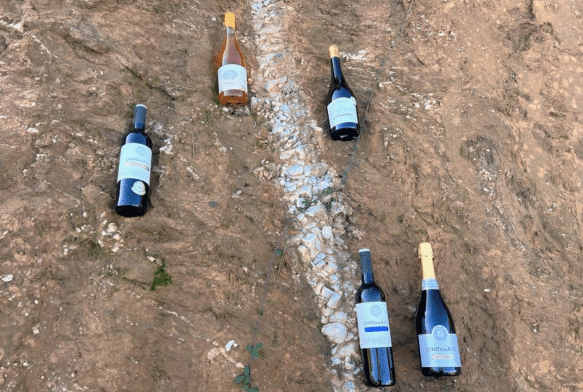
It is precisely the traditional method that we use for Quinta da Raza’s sparkling wines. And, in fact, our family of sparkling wines has recently grown with the addition of two more members—the Quinta da Raza Espumante Branco Bruto 2021 and the Quinta da Raza Espumante Tinto Bruto Natural 2023 —which have joined the already well-known Quinta da Raza Espumante Branco Bruto Natural.
In the Quinta da Raza Brut White Sparkling Wine 2021, we once again find the grape varieties Alvarinho (45%), Avesso (45%) and Arinto (10%), cold-pressed, followed by temperature-controlled fermentation in stainless steel tanks. Subsequently, bottle fermentation took place with free-floating yeasts, followed by 24 months of aging. The result is an elegant wine with fine, persistent bubbles and an enveloping, refreshing finish, ideal as an aperitif, but also to accompany suckling pig, fatty fish, and to make a statement at any festive occasion.
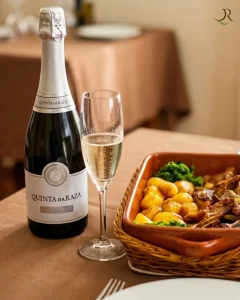
As for the Quinta da Raza Natural Brut Red Sparkling Wine 2023, it stands out as a truly distinctive product, primarily because it is a red wine in a segment particularly dominated by whites. The base wine for this red sparkling wine comes from the estate’s oldest vineyard— Vinha de Cerdeiredo —a veritable repository of ancient red grape varieties recommended for the Vinho Verde region, including Vinhão, Padeiro, Espadeiro, Rabo d’Ovelha, Borraçal, Touriga Nacional, and Azal Tinto. The first fermentation takes place in our century-old granite wine presses—dating back to 1922—followed by a second fermentation in the bottle, also with free-running yeasts, and a 12-month aging period. The result surprised even the most optimistic, producing a sparkling wine with fine, persistent bubbles and a dry finish (Bruto Natural)—enveloping and refreshing—that pairs perfectly with typical regional dishes such as cabidela rice, rojões, fatty fish (like the famous lamprey), or even suckling pig.
If we’ve piqued your curiosity, why not try one—or even both—of the new sparkling wines from the Quinta da Raza family? Don’t hesitate to come visit us and, if you’re in the area, check out our elegant wine shop! If you can’t make it in person, visit our online store and place your order. We’ll deliver the wines right to the comfort of your home. There’s no better time to enjoy a refreshing sparkling wine!
Share this article