As is well known, in recent years there has been a notable increase in the consumption and production of white wines on a global scale. This is shown by the International Grape and Wine Organization's report drawn up at the end of 2023, which compiles data collected between 2000 and 2021. On the other hand, red wines have seen a decline, most evident in the major European producers - France and Italy - although this has been offset by countries such as Argentina, South Africa, Australia and Chile.
This increase in the production and consumption of white wines is undoubtedly linked to changes in consumer tastes, starting with the search for a greater sense of freshness that white wine usually offers compared to red wine. However, other factors must also be taken into account, such as the greater technical knowledge applied in the field and in the cellar by winegrowers and winemakers, as well as the existence of more and better technology, particularly in terms of refrigeration, which has enabled the production of high quality white wines.
Deliberately avoiding an overly technical discourse, it is well known that the production of white wine is more demanding than that of red wine. Among other things, whites are more sensitive to oxidation, first and foremost because white grapes, compared to red grapes, have a lower level of anthocyanins, pigments that, in addition to providing color, help preserve the wine. It is also a fact that, in the past, some white wines oxidized quickly, leading producers and consumers to prefer "new" wines that had to be drunk in a short space of time. Nowadays, however, and thanks to the spread of these new technological means, it is possible to produce long-lasting whites that evolve wonderfully in the bottle. This significant increase in the quality of white wines has helped to disassociate white wine from the summer period. Although summer is still the time of year when white wines are most consumed and sought after, it is increasingly common to hear about 'winter whites', i.e. wines with greater complexity and structure, sometimes with fermentation and/or ageing in barrels, which harmonize better with the 'heavier' and more intense foods of the colder seasons.
Portugal has been no exception to this growth in the production and consumption of white wines and has done so, fortunately, based on national grape varieties and respecting regional traditions. In this respect, it is inevitable to mention the Vinho Verde Region (RVV), which since the 1990s has given great importance to white wines, to values that are now probably close to 85% of total production. In fact, it wasn't so long ago that the region's "noble" wine was red, produced from grape varieties such as Vinhão, Alvarelhão, Amaral and Rabo d'Ovelha, among others. Today, that prominent role is occupied by white counterparts, such as Azal, Avesso, Loureiro and Alvarinho, and with great success, as the migration of indigenous grape varieties from Vinhos Verdes to other demarcated regions seems to prove.
Wine production in the Vinho Verde region has undergone a significant transformation in the last 50 years, especially in the ratio between red and white wines. Until the 1970s, red wines dominated production, accounting for more than 85% of the total. However, from the 1980s onwards, with the modernization and reconversion of production, there was a reversal of this trend and the region bet heavily on indigenous white grape varieties, such as Alvarinho and Trajadura. In terms of total production, in 1990 red wines still outnumbered whites, with 113.5 million liters compared to 87.9 million liters. The reversal occurred in the 1992/93 harvest, when white production reached 57.8 million liters, slightly above the 56.7 million liters of reds
Since then, the production of red wines has become practically residual. In the 2022/2023 harvest, of the more than 100 million liters produced in the region, only around 15% corresponded to red wines, including rosés.
This evolution reflects an adaptation to market preferences and an appreciation of the region's white grape varieties, consolidating white wines as the mainstay of Vinho Verde production.
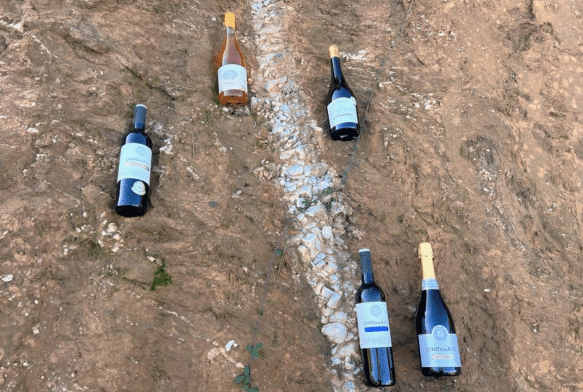
At Quinta Raza, this transition began in the early 1990s, when Diogo Teixeira Coelho undertook an extensive overhaul of the vineyard, changing and giving priority to white vines over red, in preparation for the years to come. The climate, the grape varieties, the type of soil, the cultural practices, in short, the terroirThe terroir is ideal for producing exceptional white wines, with different profiles, from those endowed with a contagious natural freshness, to the more complex and structured ones where, although they don't lack freshness either, we find other nuances, from minerality, ageing potential or gastronomic vocation.
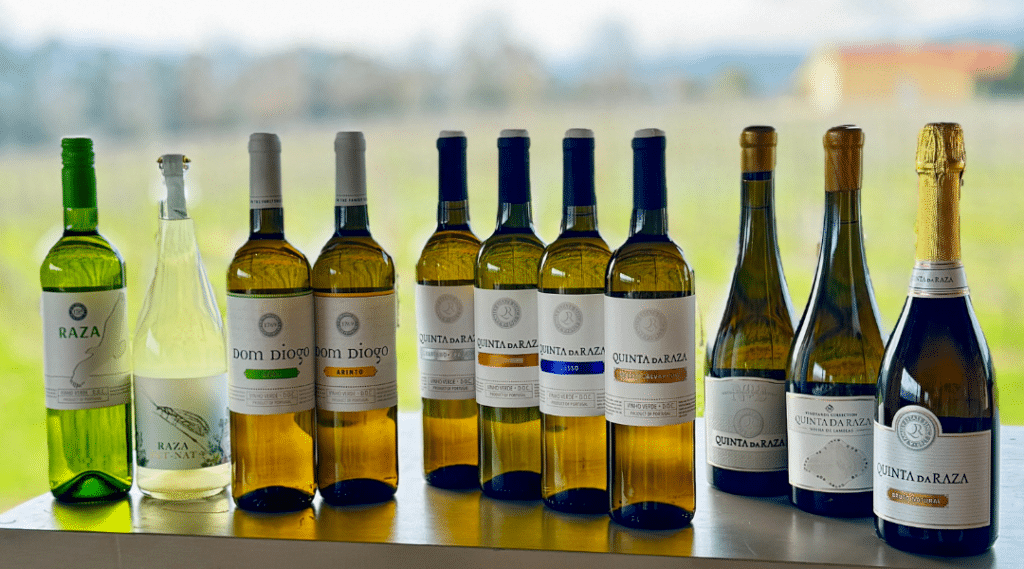
At Quinta da Raza there are white wines for all tastes and different profiles. Our ranges - Raza, Raza Nat, Dom Diogo, Quinta da Raza, Special Editions - seek, on the one hand, to highlight the full potential and scope of the RVV (and, in particular, of the Basto sub-region) and, on the other, to meet the palates of our different consumers.
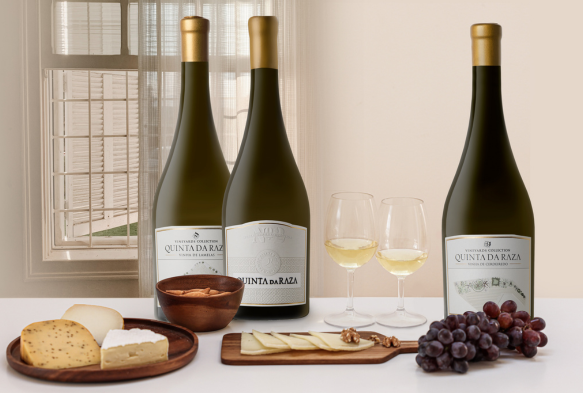
Thus, in our portfolio of white wines, you can find everything from the profile more usually associated with Vinho Verde - fresh, highly fruity and slightly fizzy - represented in the monovarietals Dom Diogo Arinto e Dom Diogo Azal and in the Raza White e Quinta da Raza Alvarinho-Trajadurato the drier and more mineral, and with ageing potential, such as the Quinta da Raza Avesso, Quinta da Raza Alvarinho e Quinta da Raza Vineyards Collection Vinha de Lamelas and even those who associate the latter characteristics with the benefits of barrel ageing, as evidenced by the Quinta da Raza Avesso-Alvarinho and Quinta da Raza Family Collection nº2. Not forgetting, of course, our Nat range, where the Raza Pet Nat Brancowith its pleasant natural gas, and the Raza Curtimentawith its great structure and delicious notes of spices and grapefruit. Another honorable mention goes to our highly gastronomic sparkling wine, Quinta da Raza Natural Sparkling Wine 2019.
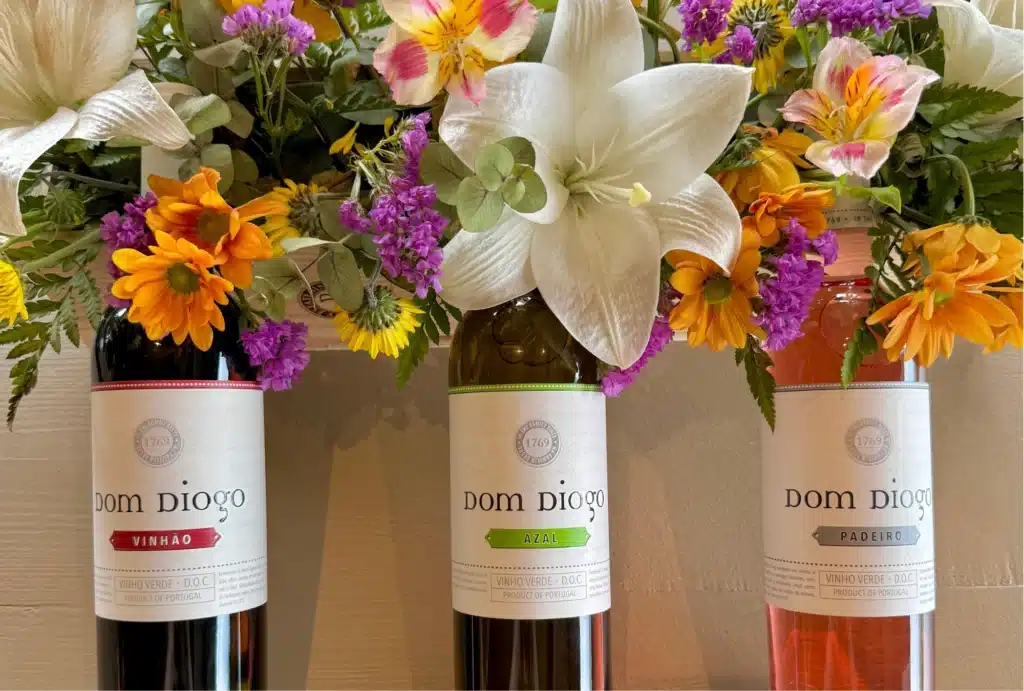
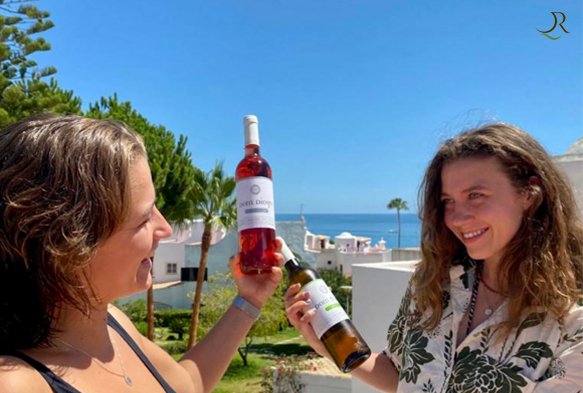
With all this, we don't mean to marginalize rosé wines, of course, and certainly not red wines. Who hasn't enjoyed the wonderful colors and vibrant aromas of Raza Roséor Pet Nat Rosé and Dom Diogo Padeiroor who has never paired a delicacy from the regional cuisine of Minho with a Dom Diogo Vinhãois missing out on a truly unique experience. After all, as someone once said, "there's a vinho verde for every moment"; add some good company and celebrate!
Share this article