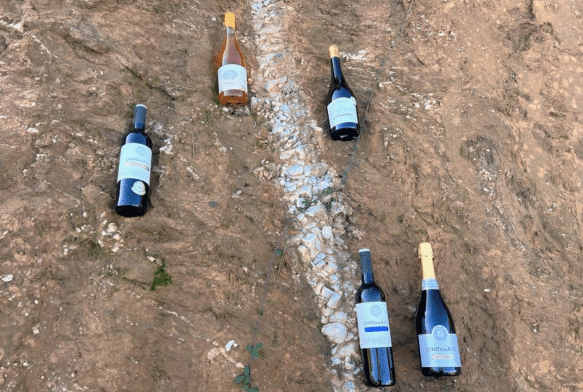
The geology and soils of Celorico de Basto—with Quinta da Raza standing out in particular—in areas such as Outeiro, Raza, Lamelas, Cascalho, Agrelo, and Gagos, define the unique identity and high quality of our wines.
This region shapes the character of the local grape varieties through a strong connection between thesoil, the climate, and people.
Each type of soil—its morphology, orientation, and elevation—has a distinct influence on each grape variety and, consequently, on what matters most to us: the wines!
Granite soilsproduce fresh, vibrant, and mineral-driven wines with lively acidity and well-defined aromas.
Shale-rich areas with clay content contributeto greater structure, body, and aging potential, addingdepth, complexity, and a more intense mineral profile.
The gentle slopes and the influence of the Tâmega River helpmoderate temperatures and preserve the natural freshness of the grapes.
From a more technical perspective, here is an overview of the soil composition of the various vineyards at Quinta da Raza, namely: Outeiro and Raza; Lamelas; Cascalho; and Agrelo and Gagos.
All of these areas are covered by Sheet 10-A (Celorico de Basto) of the Geological Map of Portugal at a scale of 1:50,000. In terms of soil science, the source is based on data obtained from the Soil Map and the Agroforestry Suitability Map at a scale of 1:100,000.
Outeiro and Raza
To facilitate a better geological and pedological interpretation, this plot will be divided into the following vineyard areas: Outeiro a Peneireiros; Tapada dos Barros, Bouça Fria, Raza de Cima and Raza de Baixo, Tapada da Troca; and finally, Sargento, Tapada da Eira, Pombeiros, and Além.
Outeiro Vineyards, Calçadas, Moinho, and Peneireiros
According to Sheet 10-A of the Geological Map of Portugal, this vineyard area is located within the Vila Nune Unit (UV), specifically on upper schists that are primarily pelitic or composed of centimeter-thick alternations of reddish-brown oxidized schist and metasilts or metarenites. It is worth noting the presence of quartz veins. With regard to soil characteristics, these vineyards are predominantly composed of Distric Cumular Anthrosol (ATcd.x), derived from schist and related rocks.
Brownish humic-umbric Cambissols derived from schist and related rocks (CMup.X) are also predominant in this area.
Tapada do Barros, Bouça Fria, Raza de Cima and Raza de Baixo, and Tapada da Troca Vineyards
According to Sheet 10-A of the Geological Map of Portugal, this vineyard area is located on the UV unit, specifically on upper schists that are primarily pelitic or composed of centimeter-thick alternations of reddish-brown oxidized schist and metasilts or metarenites. Quartz veins are also found here.
In terms of soil, the vineyards are located in the following pedological units: Umbric Leptosols on schist and related rocks (LPu.x) and thin Umbric Regosols on schist and related rocks (RGul.x).
Sargento, Tapada da Eira, Pombeiros, and Além
According to Sheet 10-A of the Geological Map of Portugal, this vineyard is located on the UV, specifically on upper schists that are primarily pelitic or composed of centimeter-thick alternations of reddish-brown oxidized schist and metasilts or metarenites. It should be noted that the Além vineyard is close to an acidic and intermediate volcanic tuff, which is sometimes found in the UV. In terms of soil type, an Anthrosol Cumulic Distric (ATcd.x) predominates, formed from schist and related rocks.

Slats
According to Sheet 10-A of the Geological Map of Portugal, the Lamelas vineyard is located within the UV unit, on upper schists—primarily pelitic or composed of centimeter-thick alternations of reddish-brown oxidized schist and metasilts or metarenites—as well as on skarnified intermediate- to basic volcanic tuff. The lower section may be influenced by acidic and intermediate volcanic tuff. Regarding its pedological characteristics, two dominant units are present: Distric Cumular Anthrosol (ATcd.x), derived from schist and related rocks, and Umbric Leptosols on schist and related rocks.
Gravel and Aggregate
From a geological perspective, we must distinguish between the two vineyard plots, both located within the UV. The Cascalho vineyard lies on upper schists, which are primarily pelitic or composed of centimeter-thick alternating layers of reddish-brown oxidized schist and metasilts or metarenites. Of particular note is the presence of a quartz vein. As for the Agrelo vineyard, this area features acidic and intermediate volcanic tuff, forming elongated lenticular masses that sometimes extend over 2 km.
With regard to soil characteristics, the Entre-Douro and Minho Soil Map (1:25,000 (DRAEDM-1995)) shows that both vineyards are located in an area dominated by Distric Cumular Anthrosol (ATcd.x), composed of schist and related rocks.
Gagos
According to the Geological Map of Portugal—Sheet 10-A—the Gagos vineyard is located on coarse-grained porphyroid granite, containing two types of mica and consisting primarily of biotite, known as the Amarante and Celorico de Basto Granite. The soil of this vineyard is described, according to the soil map, as an area of cumulo-dystrophic anthrosol derived from granites and related rocks (ATcd.g), as well as orthic dystrophic regosol derived from granites and related rocks (Rgdo.g).
If you’ve made it this far, congratulations! You’re true connoisseurs; for while it’s important that our favorite wines be of excellent quality, it’s equally important to understand that the uniqueness and variety of the soils found throughout Quinta da Raza contribute greatly to that.
Cheers!
Share this article